Consign Boston To Flames…Ravage New England – these were the orders given to Louis Frederic de la Rouchfecauld de roye the Duc D’Anville by the French Command. The force sent by the French commanded by D’Anville was the largest military force sent to the New World until the American Revolution. News of the fleet sent panic throughout New England as fears of Catholic French Invasion gripped the colony. Yet, the expedition was a complete failure and is largely forgotten to history. In this article we will examining the Duc D’Anville expedition – the forgotten French Fleet.
In the 1740’s the American Colonies once again found themselves at war with France and her Indian allies. These conflicts had been going on for over half a century starting with King Williams War in 1688 and had periodically flared up, often with the advent of War in Europe.
When the War of the Austrian Succession broke out in Europe, Britain again found herself at war with France and subsequently, the American Colonies were now at war with The French in Canada and her Indian allies. To the Americans, the War was called King Georges War after the reigning British monarch George II. The colonists saw these wars as follies of the reigning monarch and named the wars after them (Hence King Williams War, Queen Anne’s War and King Georges War).
King Georges War is easily the most forgotten colonial war compared to Queen Annes War or King Williams War, both of which are filled with imfamous episodes like the Death of Major Waldron or the Raid on Deerfield. Most of the battles of the war were confined to Nova Scotia (known at the time as Acadia) where rival British and French colonies fought over supremacy.
Some battles were fought in the colonies themselves, notably joint French and Indian raids in Upstate New York and Western Massachussetts. The big event of the war came when British and Colonial Forces lead by American Sir William Pepperrell besieged and captured the massive French Fort at Louisbourg. Both the story of Pepperrell and the Fall of Louisbourg deserve to be told in their own right, but the bottom line was that the largest French Fort in Acadia had fallen and the remainder of French Holdings in Acadia/Nova Scotia as well as all of Canada were now under threat.
To relieve French Canada, King Louis XV of France tasked the Duc D’anville with a massive invasion fleet of 11,000 men and 64 ships set to recapture Nova Scotia. After Nova Scotia was under French control, D’anville was ordered to “Cosign Boston to Flames, Ravage New England and Waste the British West Indies”. In simple terms D’anvilles orders were to destroy British North America.

Louis Frederic de la Rouchfocauld de roye, the Duc D’Anville
News of the fleet sent panic through New York and New England both over fears of invasion and devastation, but also over fears that the Protestant colonies would be subject to the yoke of Catholic domination. Yet bad luck plagued the expedition from the start. Before the fleet was even out of port, the fleet was ravaged by storms in the Bay of Biscay. Then typhus and scurvy broke out in the ships. The disease ridden crew took three months to cross the Atlantic, during which storms wreck havoc on the ships with lightning even hitting a few.
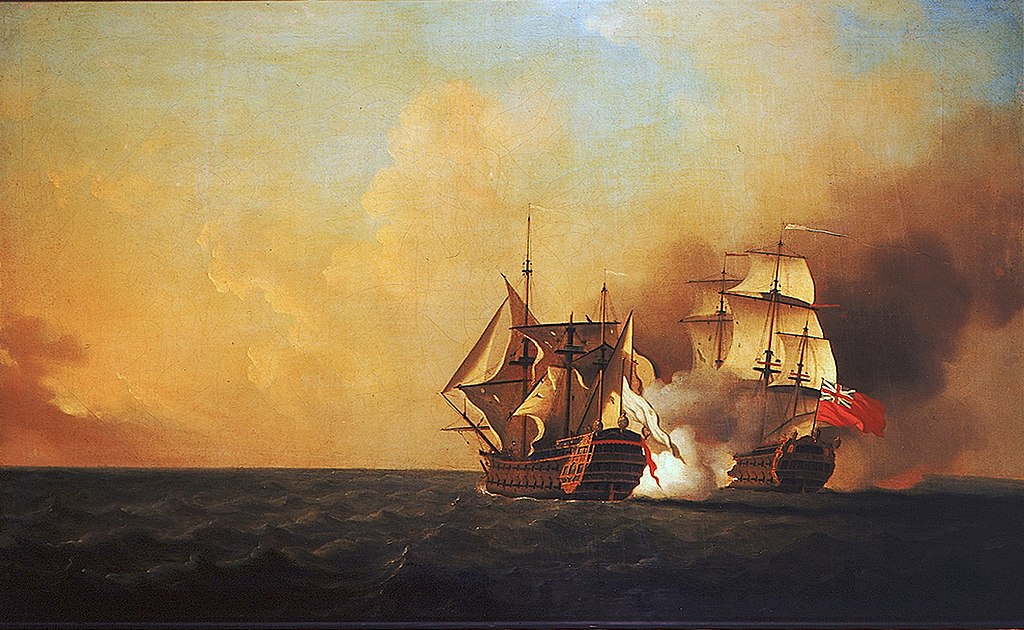
Two of D’Anville’s ships Le Mars and Le Raphael were set to return to France. The two got separated and Le Mars was captured in a duel by HMS Nottingham, an incident immortalized in the painting at the top of this article.
By the time the fleet finally reached Nova Scotia, hundreds had died of disease and hundreds more were on their death bed. The expedition was planned in conjunction with a land assault from Quebec on the capitol of British Nova Scotia Annapolis Royal, but with news of the condition of the expedition the army began to withdraw.
With the fleet anchored in Halifax harbor and hundreds of men dying of disease, the Duc D’Anville died of a stroke. With the expedition in tatters D’Anville;s replacement sailed the remnants of the fleet back to France, thus ending the French threat.
After this the French did not try again to reinforce their holdings in North America and the failure of the expedition would help push France to peace. In what was seen as a betrayal by many colonists, the Treaty of Aix-la-Chapelle which ended the War of the Austrian Succession including King George’s War restored all borders to pre war status, ceding all captured land in Nova Scotia back to the French. The failure to resolve the disputes on the continent would help lead to the advent of the French and Indian War less than 10 years later.
The expedition while largely forgotten today was immortalized by Henry Wadsworth Longfellow’s poem A Ballad of the French Fleet. Further, the expedition has gained recent attention as the result of conspiracy theories regarding it suggested by the History Chanel discovery show the Curse of Oak Island, which suggests the expedition could have a part to play in the Oak Island mystery. Either way the expedition is part of a long forgotten history of colonial wars integral to America’s past.
This Post was authored by Adam Danberg.
 Hudson History
One response to “The Duc D’Anville Expedition”
Enjoyed learning about this expedition. Your other pieces were also informative and entertaining.
LikeLiked by 1 person